2026.06.01.
Lee Ha-kyung
The author is a senior columnist at the JoongAng Ilbo.
Former President Roh Tae-woo agreed after the three-party merger to pursue a constitutional revision establishing a parliamentary cabinet system with Kim Young-sam and Kim Jong-pil. When political adviser Lee Hong-koo learned of the plan through a scoop by then JoongAng Ilbo reporter Park Bo-kyoon on May 29, 1990, he objected directly to the president.
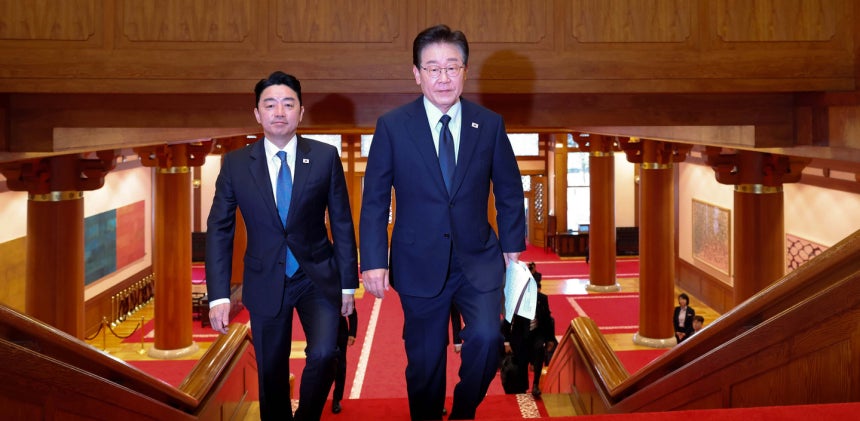
President Lee Jae Myung, right, arrives for work at the Blue House on the morning of May 6. At left is Presidential Chief of Staff Kang Hoon-sik. [JOINT PRESS CORPS]
According to the biography “Lee Hong-koo” by Kim Hak-joon, Lee argued that Roh’s greatest political asset was the June 29 Declaration, which promised direct presidential elections. Abandoning that principle would betray the public and discard the foundation of Roh’s political legitimacy. Though personally supportive of a parliamentary system, Lee believed constitutional change should not be pursued through a secret political bargain. The proposal ultimately collapsed amid strong opposition from Kim Young-sam.
The episode offers a lesson as President Lee Jae Myung approaches the first anniversary of his inauguration. His approval ratings remain stable in the 60 percent range. By emphasizing pragmatic centrism and maintaining close attention to state affairs, he has secured broad public support. The ruling camp’s local election strategy has effectively become, “We have Lee Jae Myung.”
Yet a serious political threat looms: efforts to cancel criminal prosecutions involving the president.
On April 30, the Democratic Party leadership introduced the Special Counsel Act on Investigating Allegedly Fabricated Indictments by Yoon Suk Yeol’s Political Prosecutors. Under the proposal, a special counsel appointed by President Lee would have authority to withdraw prosecutions.
The opposition has condemned the bill as allowing a suspect to appoint the investigator responsible for his own case. Critics have also described it as an unjust privilege. Concerned about public backlash, the ruling camp has delayed consideration of the measure until after the local elections.
The controversy raises questions that extend beyond politics. If a special counsel backed by the legislative majority can erase cases already under trial or even finalized by the courts, many would see it as violating basic fairness. It also challenges the constitutional principle of separation of powers.
Article 101 of the Constitution states that judicial authority belongs to courts composed of judges. The special counsel system was created to ensure independent investigations free from political pressure. Using such a mechanism for the benefit of a sitting president appears contrary to its original purpose.
The absence of strong internal opposition within the ruling camp is striking. Had there been an adviser willing to offer the kind of candid warning once delivered by Lee Hong-koo, the administration might have avoided becoming entangled in constitutional controversy at a politically sensitive moment.
The debate has also derailed broader constitutional reform efforts. A constitutional amendment jointly proposed by six parties, excluding the People Power Party (PPP), recently failed. The proposal sought to include the Bu-Ma (Busan-Masan) Democratic Protests and the spirit of the May 18 Gwangju Democratization Movement in the Constitution’s preamble while strengthening parliamentary oversight of martial law and expanding local autonomy.
Few objected to those goals themselves. The problem was that the ruling party was simultaneously pursuing legislation that could nullify prosecutions involving the president. Critics argued that seeking a better Constitution while appearing unwilling to respect the current one undermined the credibility of reform efforts. The PPP’s opposition therefore carried some persuasive force.
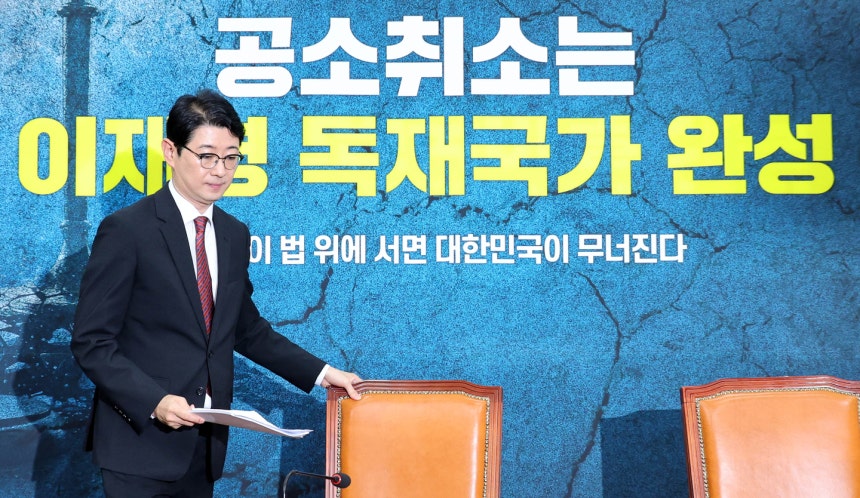
Rep. Joo Jin-woo, chair of the People Power Party’s special committee opposing the prosecution-cancellation special counsel bill, attends the committee’s first meeting at the National Assembly on May 19. A slogan in the background reads, “Cancelling prosecutions completes Lee Jae Myung’s dictatorship.” [LIM HYUN-DONG]
A core principle of modern constitutional government is that no one should be the judge in his own case. France offers a useful example. Former President Jacques Chirac faced renewed legal proceedings after leaving office and received a suspended sentence in 2011 related to misconduct during his tenure as mayor of Paris. Former President Nicolas Sarkozy was investigated and prosecuted after leaving office and was sentenced to prison last year. Constitutional immunity for a sitting president exists to ensure stable governance, not to provide permanent protection from accountability.
President Lee should therefore instruct his party to abandon efforts to create a special counsel empowered to cancel prosecutions. As head of state and chief executive, he has a responsibility to place the national interest and the rule of law above personal concerns.
President Lee must resist the temptation to put the interests of private citizen Lee Jae Myung ahead of constitutional principles. Korea is already witnessing the consequences faced by a former president accused of disregarding constitutional limits. If prosecution cancellation becomes reality after the local elections, another political crisis could emerge.
Some observers, including figures involved in creating the Corruption Investigation Office for High-ranking Officials and civic groups such as Citizens' Coalition for Economic Justice, have expressed concern. Public opinion also appears uneasy.
The deeper issue may be Korea’s presidency itself. Over time, many leaders seem to become consumed by the power associated with the office. The PPP has pledged to pursue constitutional reform aimed at dispersing presidential authority under a proposed Seventh Republic framework. Whether such efforts succeed remains uncertain. What is clear is that abandoning the prosecution-cancellation proposal should come first. That would be the surest way to avoid political turmoil and improve the chances of a successful presidency.
이재명 정부의 성공을 위협하는 복병
이하경 대기자
노태우 대통령은 3당 합당 이후 김영삼·김종필과 내각제 개헌을 추진하기로 했다. 1990년 5월 29일 중앙일보 박보균 기자의 특종으로 이 밀약(密約)을 알게 된 이홍구 정치특보는 대통령 면전에서 30분 동안 이의(異議)를 제기했다. 당신의 정치적 자산은 대통령을 직선제로 선출한다는 6·29 선언 하나뿐인데, 직선제를 바꾸는 것은 국민에 대한 약속을 깨고 자산을 버리는 것이라고 비판했다. 국민의 반발이 커서 실현되기 어려울 것이라고도 했다. 이홍구는 내각제론자지만 의회민주주의 절차가 아닌 ‘밀약’의 형태로 추진하는 것은 옳지 않다고 판단했다(『이홍구 평전』 김학준). 내각제 개헌은 김영삼의 강력한 반발로 무산됐다.
취임 1주년을 맞는 이재명 대통령의 지지율은 안정적인 60%대다. 중도실용 노선으로 균형을 잡고, 빈틈없이 국정을 챙기면서 국민의 마음을 얻었다. 여권의 지방선거 전략이 “우리에겐 이재명이 있다”일 정도다. 그러나 무서운 복병(伏兵)이 기다리고 있다. 대통령 자신에 대한 공소(公訴)취소 문제다. 민주당 원내 지도부는 4월 30일 ‘윤석열 정치검찰 조작기소 진상규명 특검법’을 발의했다. 이 대통령이 임명하는 특검이 공소취소 권한을 갖게하는 법이다. “도둑이 경찰을 임명하는 것”이라는 야당의 반발, “부당한 특권”이라는 여론의 역풍이 거세다. 놀란 여권은 지방선거 이후로 법안 처리 일정을 미뤘다.
다수당의 입법 권력을 등에 업은 특검이 재판이 진행 중이거나 확정판결이 난 사건을 없는 것으로 만들면 반칙이다. 범부(凡夫)의 상식과도 충돌한다. 헌법이 규정한 삼권분립 원칙과 사법 시스템은 걸레가 된다. 헌법 101조 1항은 “사법권은 법관으로 구성된 법원에 속한다”고 했다. 특검은 집권세력의 압력으로부터 수사의 공정성을 지키기 위해 도입된 제도다. 권력자인 현직 대통령을 위한 특검은 취지를 부정하는 괴물이다. 그런데도 대통령의 어떤 참모도 위헌임을 경고하지 않았다. 이홍구 같은 양심적이고 냉철한 참모가 있었다면 어땠을까. 여권 전체가 위헌 시비에 휘말리고 선거 판세가 흔들려 격전지 후보가 비명을 지르는 일은 없었을 것이다.
이 소용돌이 속에서 안타까운 일이 벌어졌다. 국민의힘을 제외한 여야 6개 정당이 공동발의한 개헌안이 무산되고 만 것이다. 헌법 전문(前文)에 부마 민주항쟁과 5·18 정신을 명시하고, 계엄에 대한 국회 통제와 지방분권을 강화하자는 데에 누구도 반대할 명분은 없었다. 그러나 집권당이 입법 권력으로 대통령 공소취소를 추진하는 상황이 문제였다. 지금 있는 헌법도 안 지키면서 더 나은 헌법을 만들겠다는 건 난센스다. 이걸 용납할 수 없다는 국민의힘의 반대 이유는 설득력이 있다.
‘누구도 자기 사건의 재판관이 될 수 없다’는 철칙은 근대 법치국가 운영의 대전제다. 프랑스의 최근 사례는 중요한 준거가 될 것이다. 시라크 대통령은 파리시장 시절 공금 횡령 관련 재판이 퇴임 직후 재개돼 2011년 집행유예를 선고받았다. 리비아 독재자 카다피에게 뒷돈을 받은 사르코지 대통령은 퇴임 이후 수사와 재판이 재개돼 지난해 징역 5년을 선고받고 감옥에 들어갔다. 프랑스 헌법 67조가 현직 대통령에게 면책특권을 부여한 것은 국정의 안정적 운영을 위한 것이지 권력자의 죄를 영원히 덮자는 취지가 아닌 것이다.
이 대통령에게 직언하는 사람이 없는 것은 유감이다. 그렇다면 대통령이 스스로 여당에 공소취소 특별법 추진을 중단하라고 딱부러지게 요구해 헌법 수호 의지를 보여야 한다. 대통령은 국가 원수이자 행정부의 수반이다. 사적(私的) 이익보다 국익과 법 질서를 수호해야 할 의무가 있다. 대통령 이재명이 자연인 이재명의 유혹을 제압해야 한다. 그렇지 않으면 국민이 위임한 권력에 대한 배임행위가 된다. 지금 우리는 헌법을 무시한 전직 대통령이 철저하게 단죄되는 모습을 보고 있다. 만일 지방선거 이후 공소취소가 현실이 되면 또 다른 비극이 시작될 것이다. 여권이 만든 공수처도 위헌성을 지적했고, 시민단체인 경실련도 우려하고 있다. 여론도 심상치 않다.
이 나라에선 멀쩡하던 사람도 대통령만 되면 권력에 취해버린다. ‘대통령’이라는 호칭이 원인을 제공하고 있다. 19세기 일본 지식인은 미국의 ‘프레지던트(president)’를 “크게(大), 모두를 거느리고(統), 다스린다(領)”는 뜻의 ‘대통령(大統領)’으로 조어(造語)했다. 국민을 섬겨야 할 일꾼에게 천부당만부당한 극존칭이다. 경험 세계의 한계 때문에 발생한 번역 오류가 주권자 위에 군림하는 전제군주를 탄생시켰다. 국민의힘도 하반기 국회에서 대통령 권한을 분산하는 7공화국 개헌을 하겠다고 다짐했다. 여야는 머리를 맞대고 시대착오적 호칭부터 정리하기 바란다. 물론 이 대통령이 공소취소 특검을 폐기하는 것이 최우선이다. 카오스를 피하고 성공한 대통령이 되는 길이다.
This article was originally written in Korean and translated by a bilingual reporter with the help of generative AI tools. It was then edited by a native English-speaking editor. All AI-assisted translations are reviewed and refined by our newsroom.
Copyright ⓒ 코리아중앙데일리. All rights reserved.
'Opinion & Column' 카테고리의 다른 글
| 순국 열사 지키는 보훈부 장관이 “인민공화국”이라니 (0) | 2026.06.02 |
|---|---|
| 선거 앞두고 이어지는 대통령의 거친 언행 (0) | 2026.06.02 |
| 빈소 없는 장례 (0) | 2026.06.02 |
| ‘사요나라, 아라시’와 성숙한 팬덤 (1) | 2026.06.02 |
| 6·3 지방선거 후 닥칠 정치폭풍 (0) | 2026.06.02 |